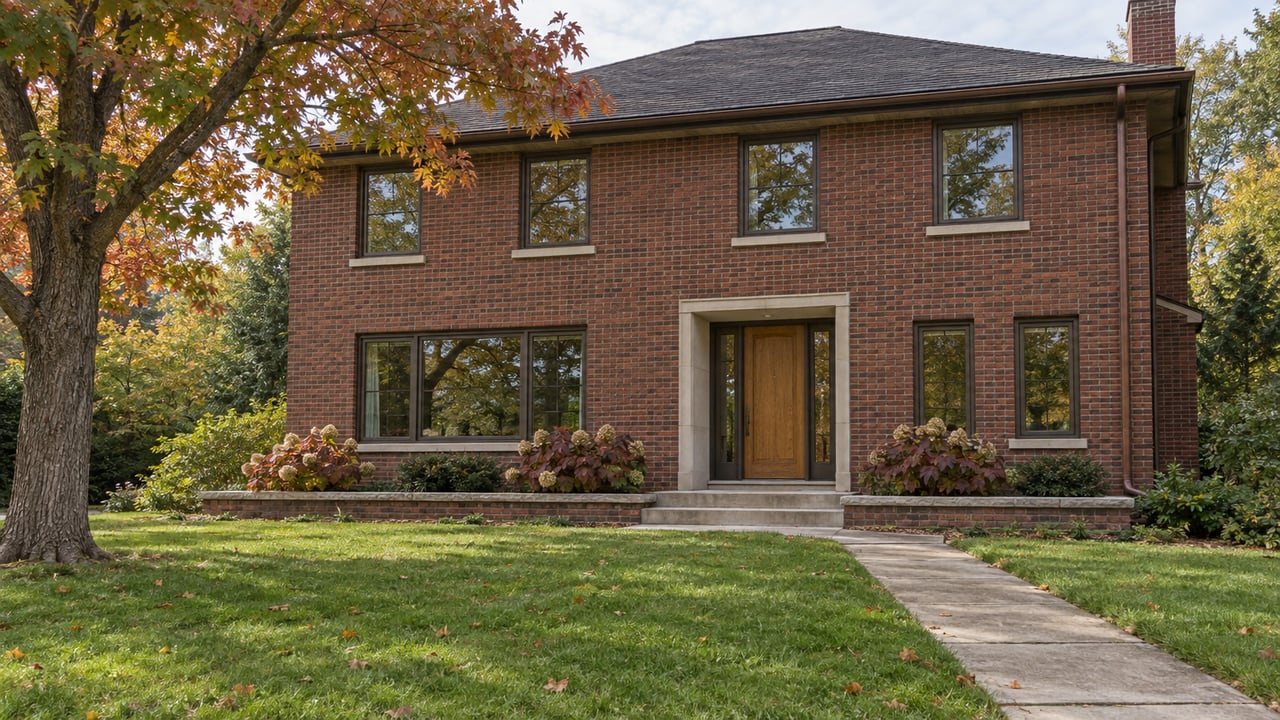
In July, a 1920s California-style bungalow at 639 S. Elmwood Ave. listed for $995,000 and closed nineteen days later at $1.3 million after what one longtime area agent called an incredible bidding war, as reported by Oak Park. A few blocks over on the same street, a four-bedroom with pocket doors and original stained glass went for $810,000 in May after listing at $720,000. Both homes sit inside Oak Park's Gunderson Historic District, a pocket of American Foursquares built by a father-and-sons development firm in the early 1900s.
If you're comparing neighborhoods right now and you've heard that historic designation means extra cost and extra hassle, the sales themselves seem to confirm it. These are expensive houses. What the sale prices don't tell you is why they're expensive, and the reason turns out to have almost nothing to do with the historic label stamped on the deed.
What a historic designation actually requires
Oak Park has three locally designated historic districts written into its village code: the Frank Lloyd Wright-Prairie School of Architecture Historic District, the Ridgeland/Oak Park Historic District, and the Gunderson Historic District. Buyers often assume that owning inside one of these boundaries means every window replacement or paint color needs a hearing in front of a preservation commission.
It mostly doesn't. According to Oak Park, village staff studied this directly this spring, at the request of Trustees Derek Eder and Cory Wesley, comparing permit outcomes and demographic patterns inside the three districts against the rest of the village. The finding: no significant variance in permitting behavior between historic and non-historic parts of town. More specifically, 95 percent of projects in the historic districts get approved by staff without ever going in front of the Historic Preservation Commission. The commission only steps in for exterior alterations, additions, new construction, or demolition, and even then, most of that traffic clears at the staff level.
So the regulatory friction that buyers price into their mental math when they see "historic district" on a listing is, by the village's own data, mostly a phantom cost. The same study found something else worth sitting with: historic districts actually contain more of what planners call missing middle housing, because they predate the later-era zoning changes that discouraged multi-unit buildings elsewhere in the village. Staff also tabbed the Ridgeland district as the most affordable and most diverse of the three, while the core of the Frank Lloyd Wright district has been, in the study's words, the wealthiest part of Oak Park since its founding.
Three districts, three different bets
If the permitting process isn't the differentiator, what is? Character, age, and the kind of buyer each district has historically attracted.
| District | Designated | Character | What's driving demand now |
|---|---|---|---|
| Frank Lloyd Wright-Prairie School | 1972 local, 1973 National Register, expanded 2009 and 2012 | More than 1,700 contributing buildings, 23 designed or remodeled by Wright himself | Long-standing premium; wealthiest part of the village since it was platted |
| Ridgeland-Oak Park | 1983 National Register, 1993 local | The village's largest district by acreage, spanning Victorian-era homes through Craftsman bungalows and early apartment buildings | Tabbed by the village's own study as the most affordable and most diverse of the three |
| Gunderson | 2002, expanded 2003 | Two subdivisions of American Foursquares built by S.T. Gunderson and Sons between 1905 and 1920, distinguished by front porches, oak woodwork, and stained glass | The district currently in a visible bidding-war moment, per this summer's closings |
Three different eras, three different buyer profiles, and three different price points, all operating under nearly identical permitting rules. That's the part a median-price search on any portal will never surface. The premium at 639 S. Elmwood wasn't a payment for the privilege of dealing with red tape. It was a payment for a house that had been restored with what the listing agent described as sensitivity to the original design, at a moment when buyers in that pocket of Oak Park have swung hard back toward preserving wood trim and vintage detailing after years of favoring stripped-down, painted-white flips.
That shift in taste, not the historic overlay itself, is what's compressing inventory and pushing prices past ask in Gunderson right now. A buyer weighing Gunderson against a comparable non-historic block elsewhere in Oak Park should expect to compete on the house, not on the paperwork.
The number that actually moves your bill
Here's where the story gets more useful for anyone doing real budgeting, because there is a genuine cost mechanism at work in Oak Park this year, and it has nothing to do with which historic district you're in. It has to do with what type of home you buy.
Oak Park Township went through its triennial reassessment this spring, with notices mailed to property owners on May 6, 2026. As a whole, the combined assessment increase across the township came in at 25 percent, reflecting how much the market strengthened since the last reassessment in 2023, when the median Oak Park home sale sat at $513,000. By this year's reassessment, that median had climbed to $595,000.
The part that matters for comparison shopping is how unevenly that 25 percent landed. Single-family homes rose about 24 percent in assessed value. Condos rose about 25 percent. Townhomes rose only about 11 percent. Apartment buildings jumped 28 percent, and commercial property rose 21 percent.
Assessed value increases don't translate one-to-one into tax increases, and Oak Park Township Assessor Ali El Saffar has been direct about correcting that assumption, noting that people often think a 25 percent assessment jump means a 25 percent tax jump, when the two numbers work very differently. What the divergence does mean is a shift in each property type's share of the total tax burden. A property that rose less than the township's combined 25 percent, like a townhome at 11 percent, will carry a smaller relative share of next year's bill. A single-family home that rose closer to that 24 to 25 percent average will carry roughly the same share it always has. It's the properties that rose well above that combined average, whatever their type, that will feel the difference on the 2027 bill.
That's a genuinely useful data point for anyone comparing a single-family purchase in Gunderson or the Wright district against a townhome purchase elsewhere in Oak Park. The historic label on the deed won't change your tax exposure. The property type will.
For scale, two of this summer's Gunderson closings came with 2023 tax bills attached to their listings: roughly $16,000 a year on the $876,000 sale at 734 S. Gunderson, and roughly $20,000 a year on the $810,000 sale at 704 S. Elmwood. Those numbers predate this year's reassessment and will move again once 2027 bills go out, but they set a realistic floor for what carrying costs look like on a vintage single-family home in this district today.
Weighing the three districts against your own numbers
If you're comparing Oak Park sub-neighborhoods with an actual purchase in mind, a few questions matter more than the historic designation itself:
- Are you buying a single-family home, a condo, or a townhome? That answer will shape your tax trajectory more than which historic boundary you land inside.
- Do you want Prairie School architecture and the Wright name, a wider mix of Victorian-to-Craftsman housing stock at a lower entry price, or the Foursquare character and porch-heavy streetscape that's driving this summer's Gunderson activity?
- Are you budgeting for a renovation? Given that 95 percent of projects clear staff review without a commission hearing, plan your renovation timeline around your contractor's schedule, not around an assumed bureaucratic delay.
None of these questions can be answered by a median price alone, and none of them show up on a portal listing. They show up in the village's own permitting data, in this year's reassessment notices, and in what agents on the ground are actually seeing close.
A few questions worth asking before you write an offer
Does buying in one of Oak Park's historic districts mean I need village approval before I renovate? Only for exterior alterations, additions, new construction, or demolition, and even those mostly clear at the staff level. The village's own review found 95 percent of historic-district projects never reach the Historic Preservation Commission at all.
Will my tax bill rise by the same percentage as my assessment? No. Oak Park Township's own assessor has been explicit that an assessment increase and a tax bill increase are different calculations. What matters more is how your property's increase compares to the township's overall combined increase, which came in around 25 percent this cycle.
Which Oak Park historic district is the most affordable entry point? Based on the village's own comparative study, Ridgeland was identified as the most affordable and most diverse of the three districts, in contrast to the Frank Lloyd Wright core, which has carried a premium since the village's founding.
If you're weighing a purchase in Gunderson, Ridgeland, the Wright district, or anywhere else in Oak Park, and you want the actual numbers behind a specific block rather than a village-wide average, Naja Morris can walk you through what a given property's tax history and district really mean for your budget. Get access to her private listings or schedule a consultation to start comparing real houses instead of median prices.
This article is general information, not legal, tax or financial advice. Consult a qualified professional about your situation.