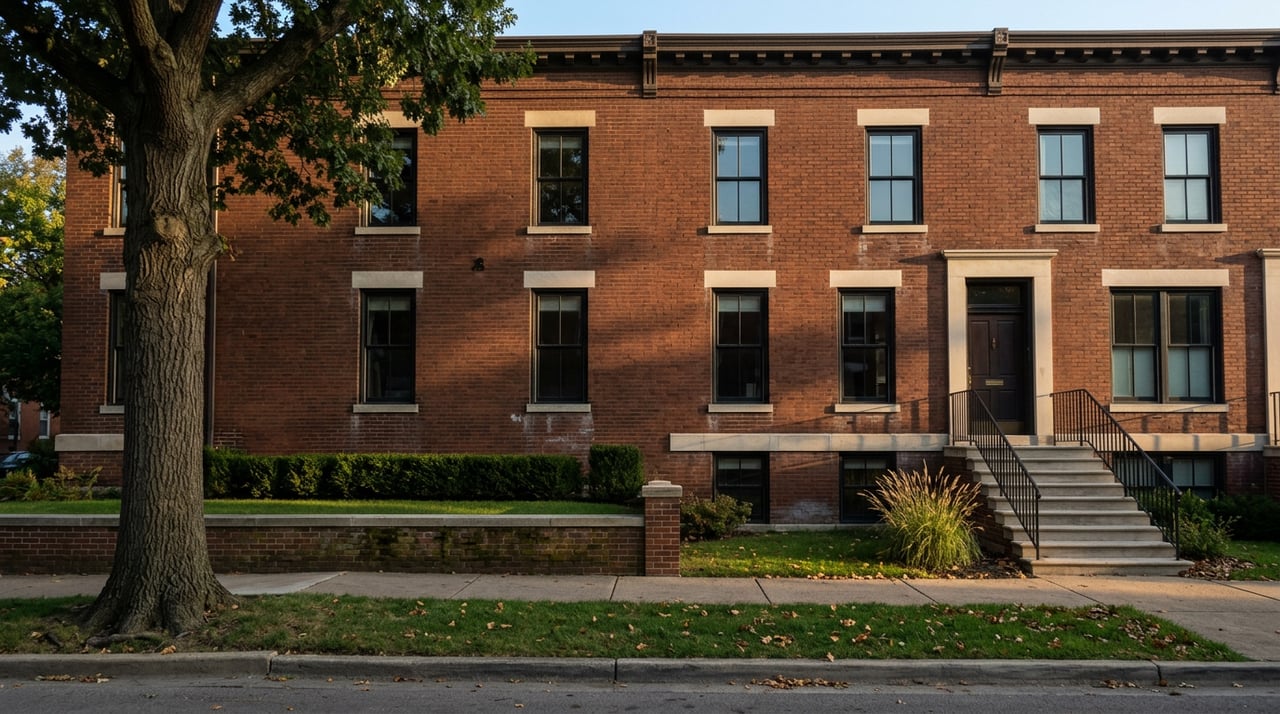
A few years back, a couple who had lived in Bronzeville for two decades bought a run-down Victorian greystone on Dr. Martin Luther King Jr. Drive for $525,000. The utilities worked, but every system needed updating, and the buyers budgeted about a year to bring the whole house current. That is the shape of a typical Bronzeville rehab: a beautiful limestone facade, original woodwork worth saving, and a long list of systems hiding behind the walls that nobody sees until the permits start.
Most of that list gets covered in a home inspection. One item on it usually does not: the pipe running from the street to the meter, and whether it is made of lead.
The Box You're Allowed to Leave Blank
According to Nolo, Illinois sellers fill out a Residential Real Property Disclosure Report with yes, no, or unknown answers. Marking "unknown" on a question you genuinely don't know the answer to is legal. Nobody is required to dig up their yard to find out.
That matters because most Bronzeville homeowners are not actually being told what is in the ground. According to Suburban Plumbing Experts, the city was legally required to notify roughly 900,000 affected Chicago households, landlords, and tenants about their service line status. As of mid-2025, only about 8 percent had received that notice. The Illinois Department of Public Health's own waiver form spells out the disclosure trigger plainly: once a water utility has identified a property as having a lead or suspected-lead line, and the owner declines the city's offer to replace it in full, disclosure at any future sale becomes required under state law. Until that notification happens, though, the box can stay blank honestly, not because the line is safe, but because the paperwork hasn't caught up to the house yet.
For a neighborhood built out mostly before 1930, that gap is worth sitting with.
A City-Wide Problem With a South Side Concentration
Chicago has roughly 412,000 lead or suspected-lead service lines out of about 491,000 total, based on the city's own April 2025 inventory, the largest count of any city in the country. That burden is not distributed evenly. In majority-Black census tracts, 89 percent of service lines need replacement, compared to 74 percent in majority-white tracts and 65 percent in the city's majority-Asian tracts around Chinatown. The nine community areas with the highest share of pipes needing replacement are all on the South Side.
Lead pipe was standard practice under Chicago's own municipal code until the national ban in 1986, and Bronzeville's greystones and rowhouses were largely built decades before that, many dating to the late 1800s and early 1900s. That construction era, on its own, is close to a guarantee of a lead or suspect line somewhere in the chain from the water main to the meter. A confirmed clean line in a pre-1930s Bronzeville building is closer to the exception than the rule.
The Code Doesn't Care What the Disclosure Says
Here is the part that actually changes a rehab budget. Since January 1, 2022, Illinois law has banned partial lead service line replacement. Public Act 102-0613 requires that if any part of a lead line is disturbed or affected, the entire line has to be replaced, not patched or partially swapped. Partial replacements were banned because they can actually increase lead levels for a period after the work, not just leave the problem half-solved.
That rule has nothing to do with what the seller wrote on the disclosure form. It attaches to the physical act of disturbing the line. A rehabber who pulls a permit for new kitchen or bathroom plumbing, or a plumber who has to access the service line for any reason, can trigger the full-replacement requirement regardless of what anyone knew or disclosed at closing.
A full gut rehab of a Chicago greystone already runs $250,000 to $600,000 for a typical 2,500 to 3,500 square foot building. A lead service line replacement adds $15,000 to $40,000 on top of that, with the city-wide average landing around $35,000. On a project already sized in the hundreds of thousands, that is a real swing, and it is one that tends to surface mid-project, once a permit application or plumbing inspection reveals what has been sitting underground the whole time.
The paths available once that happens vary quite a bit in what they actually cost:
| Path | What It Covers | The Catch |
|---|---|---|
| Equity Lead Service Line Replacement Program | Free full replacement in priority neighborhoods | Limited to households at or below 80% of area median income; apply through 311 or chicago.gov/leadpipes |
| MeterSave Program | Free replacement | Requires agreeing to a smart water meter installation |
| Homeowner-Initiated Program | Waives up to $3,100 in permit and tap fees | You still pay the full line replacement cost yourself, using a licensed plumber on your own schedule |
| No action until code forces it | No upfront cost | The full $15,000 to $40,000 bill lands mid-renovation, on the permit office's timeline, not yours |
The Free Money Has a Deadline Too
Chicago's replacement program is funded in part by a $325 million federal loan for lead line work. That loan expires at the end of this year, and as of late 2025, less than a third of it had been spent. With the deadline a few months out from today, the window to count on subsidized or city-led replacement before other funding options tighten is closing along with the calendar year. Anyone hoping the city will simply get to their block before they close on a purchase or pull a renovation permit is betting against a funding clock that is already running short.
What to Actually Do Before You Write the Offer or Pull the Permit
A few concrete steps change how this plays out, depending on which side of the transaction you're on.
Look up the address before you write an offer. The city's lookup tool at chicago.gov/leadcheck, and the interactive map built by WBEZ, Grist, and Inside Climate News from the same city data, will show the known or suspected material for a specific address. An "unknown" result is common and is not the same as a clean result.
If you're selling a pre-1960s Bronzeville home, expect a buyer's inspector or attorney to check the line status independently of your disclosure form. Getting ahead of that with your own lookup, before you list, avoids a late-stage renegotiation.
If you're budgeting a rehab that includes any plumbing scope, price the possibility of a full lead line replacement into the loan or the investor pro forma before you finalize numbers, not after a permit reveals it. A $35,000 line item is a different conversation before a construction loan closes than after.
If a line comes back confirmed lead, check income eligibility for the Equity program and ask a licensed plumber about the Homeowner-Initiated fee waiver before assuming the full cost has to come out of pocket with no offset at all.
A Few Questions Worth Answering Directly
Does a lead line mean the tap water in a Bronzeville home is unsafe right now? The Chicago Department of Water Management treats the water supply with corrosion control designed to coat pipes and limit lead from dissolving into the water, which is why the city describes its drinking water as meeting national, state, and industry safety standards even with lead lines still in the ground. That coating is also part of why the state banned partial replacements: disturbing a line can compromise that protective layer and temporarily raise lead levels, which is a different risk profile than an undisturbed line sitting quietly underground.
Can a sale still close if the disclosure form says "unknown"? Yes. As noted above, an honest "unknown" answer does not block a closing on its own. It just means the physical status of the line remains an open question that a renovation permit, a future disclosure once the city notifies the owner, or a buyer's own inspection can still surface later.
What if a rehab never touches the plumbing at all? The full-replacement requirement under the 2022 law is tied to disturbing the line. A project that genuinely never touches the service line may not trigger the mandate during that specific scope of work, though the underlying line still sits there, and the city's own multi-decade replacement plan will eventually reach it regardless of what any single owner does in the meantime.
If you're weighing an offer on a Bronzeville greystone, or you're already mid-rehab and staring down a plumbing permit you didn't budget for, run the address before you sign anything else. Naja Morris works with buyers, sellers, and small-scale developers across Bronzeville on exactly this kind of project math. Get access to private listings or schedule a consultation to walk through what a lead line finding would actually do to your numbers before it shows up as a change order.
This article is general information, not legal, tax or financial advice. Consult a qualified professional about your situation.