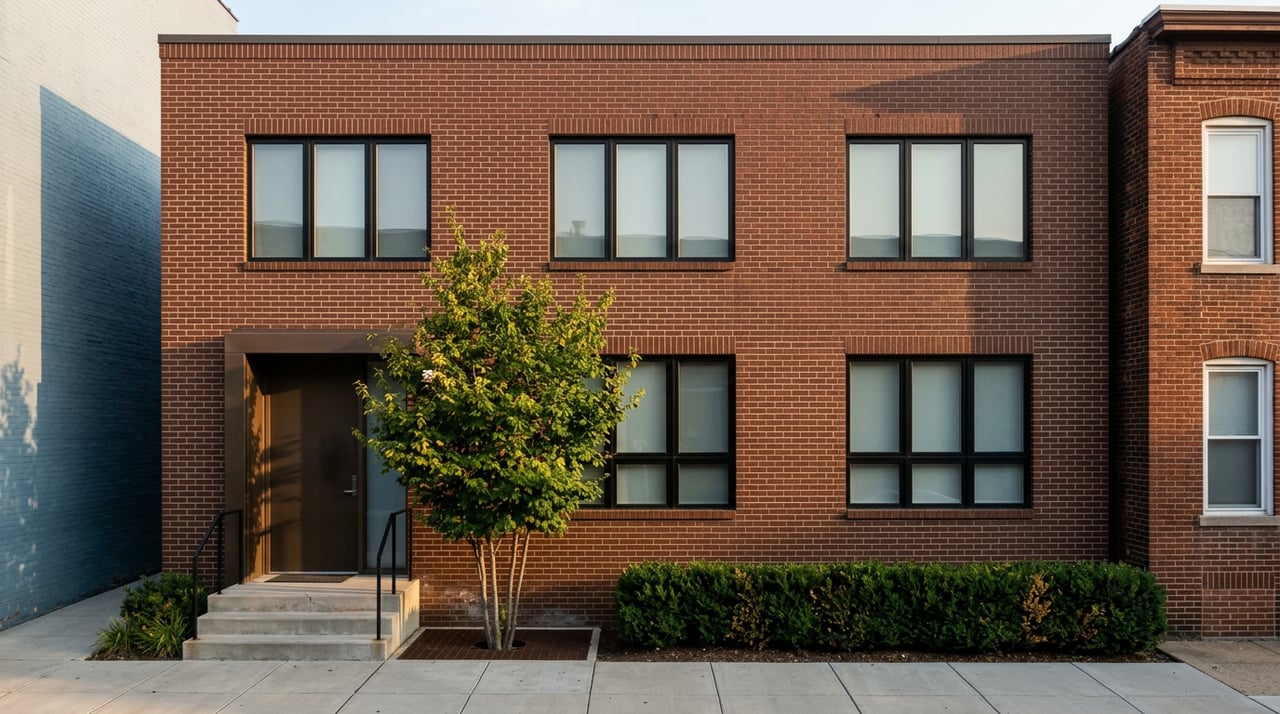
Two vacant lots, half a mile apart, on the same side of Bronzeville. One sits at 515 East Bowen Avenue, a corner parcel wedged against an alley. The other spans 3746 to 3766 South Michigan Avenue, a stretch of empty parcels that had been sitting untouched for two decades. Both are becoming housing. The paperwork behind each one moved at almost incomparable speeds, and the reason why is the actual story for anyone eyeing a lot in this neighborhood.
At Bowen Avenue, a local LLC called Landex Holding Company applied for a new construction permit on April 24, 2026, and had it in hand by May 28. Thirty-four days. The plan: a three-story, three-unit building with rear steel decks, a concrete patio, and on-slab parking off the alley, built for a reported $440,000 with Crown Construction Company as general contractor and Charles Schwartz as architect of record.
At Michigan Avenue, a $24 million, four-building, 90-unit proposal from Capricorn Design + Build needed a zoning change, a Planned Development designation, eighteen income-restricted units, and letters of support from three neighborhood institutions before it could break ground. The Chicago Plan Commission gave its first approval in December 2025. City Council followed in February 2026. Construction was slated to start that March, with the first building not scheduled for completion until December 2027.
Same neighborhood. Same general category of project, empty land becoming apartments. Completely different clocks.
Why One Took a Month
The Bowen Avenue project didn't need anyone's permission beyond a standard permit review, because a three-unit building on that lot fits within what the site is already zoned to allow. No alderman had to sponsor it. No Plan Commission hearing was required. No community letters had to be gathered. The builder submitted plans, the city's Department of Buildings checked them against code, and a permit came out the other end in a little over a month.
This is the version of Bronzeville development that doesn't make the news, because there's nothing to vote on. It's also the version that a single investor or small builder can actually execute without a coalition behind them. A comparable pattern shows up a few blocks over at 4623 South Prairie Avenue, where a builder and architect team received permits for another three-flat, one block from the 47th Street Green Line platform, following an earlier pair of three-flats the same duo built on South Langley Avenue.
Why the Other Needed a City Council Vote
The Michigan Avenue site is a different animal entirely, and not because Capricorn is a bigger or more capable developer than Landex. It's because the project asked the city for something the existing zoning didn't already grant: more density than the RM-5 designation allowed. That request triggered a rezoning to RM-5.5, which triggered a Planned Development designation, which triggered a full public process: Plan Commission review, City Council approval, and a requirement that eighteen of the ninety units be set aside for households earning 60 percent of area median income.
None of that happened quietly. Third Ward Alderman Pat Dowell backed the project publicly, along with St. Thomas Episcopal Church, The Renaissance Collaborative, and the South Side Community Art Center, whose support helped move the rezoning through. Dowell had called the long-vacant stretch an "eyesore," which is part of why the political will to rezone it existed in the first place. That kind of coalition-building is not optional when a project needs more than what the zoning code already permits. It's the toll for building bigger than by-right.
Scale Doesn't Guarantee Speed Either
It would be easy to assume the tradeoff is simple: small and fast versus big and slow but certain. The largest project on Bronzeville's near-lakefront complicates that. GRIT's Bronzeville Lakefront development, the former Michael Reese Hospital site, is a proposed $3.8 billion buildout with up to 7 million square feet of commercial, institutional, and mixed-income housing space and as many as 20,000 temporary and permanent jobs at full build-out. Infrastructure construction began there in 2023. But according to the city's own project page, GRIT is currently studying potential modifications to its design and future plans in response to shifting market conditions before proceeding with phase one.
In other words, the biggest capital commitment on the table is the one currently pausing to reassess. A few blocks south, a separate mixed-use proposal at roughly 3900 South State Street, anchored around a planned grocer near the Pershing Road intersection, is only now clearing its first phase of Plan Commission approval, on a site that's been vacant since a 2007 demolition. Scale doesn't buy a guaranteed timeline. It buys exposure to a longer list of variables that can stall a project regardless of budget.
What a Buildable Lot Actually Costs to Get Into
For an investor whose capital looks more like Landex's than Capricorn's, the more useful question isn't how the megaprojects are financed. It's how to get a lot in the first place. The Cook County Land Bank Authority maintains a rotating inventory of vacant parcels across the county, with asking prices that start as low as $350 and a countywide median closer to $49,000. Back taxes and title issues are cleared before transfer, but buyers go through a pre-qualification process and are vetted on intended use, experience, and capacity to complete the project, not a standard MLS offer. Timelines on that process run from a few weeks to a few months, which is a meaningfully different commitment than the multi-year entitlement path a rezoning requires.
The Playbook That's Already Repeating Itself
What makes the Bowen Avenue model worth watching isn't the single permit. It's that the same shape keeps recurring on different blocks. A builder and architect pairing that put up three-flats on South Langley Avenue in 2023, with one at 4605 South Langley since sold and 4634 South Langley listed for sale, later completed a similar three-flat at 4827 South St. Lawrence Avenue, now carrying an active listing at $1.395 million. That's a repeatable cycle: acquire a scattered lot, build within existing zoning, sell or hold, move to the next parcel. It doesn't require a Plan Commission hearing or a rezoning fight. It requires a buildable lot, a construction budget in the low hundreds of thousands, and a general contractor and architect who know the process.
What This Means If You're Looking at a Bronzeville Lot
The practical takeaway isn't that one path is better than the other. It's that they're not the same market, even though they get described with the same word. If your capital and timeline look like a single-lot build, the by-right path through the city's standard permit process is the one that's actually open to you, and it moves in weeks, not years. If your plan requires more density than the lot is currently zoned for, budget for a different kind of project entirely: alderman engagement, community letters, a Planned Development application, and a calendar measured in years rather than months, with no guarantee the market conditions that made sense at the start still hold by the time you finish. Reading Bronzeville's development pipeline as one undifferentiated wave of growth will lead an investor to price risk and timeline incorrectly no matter which lane they're actually in.
A Few Questions Worth Asking Before You Buy
Does my project fit the lot's current zoning, or does it need more density than that zoning allows? This single question determines whether you're looking at a standard permit review or a rezoning process that involves City Council.
Where does a buildable lot in Bronzeville actually come from? Some are held privately and sold directly. Others move through the Cook County Land Bank Authority's application process, which starts with pre-qualification rather than a standard purchase offer.
What did comparable three-flat infill actually cost to build recently? The Bowen Avenue permit put a three-unit new construction project at $440,000. That's a useful anchor for budgeting a similar scope, though site conditions, alley access, and finish level will move that number in either direction.
If you're weighing a Bronzeville lot, whether it's a single parcel you can move on this year or a larger assemblage that would take longer to entitle, Naja Morris works with investors and first-time developers on exactly this kind of decision. Get access to my private listings or schedule a consultation to talk through what a specific lot or block can actually support.